
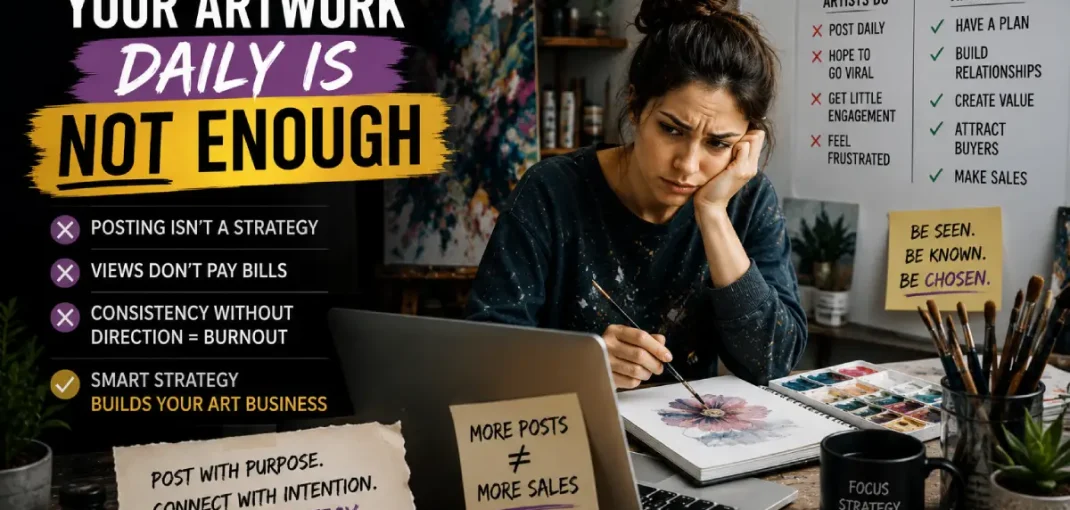
One of the most common frustrations artists experience today is this:
“I post consistently… but nothing is growing.”
You spend hours:
- creating artwork,
- filming reels,
- editing videos,
- writing captions,
- and posting regularly.
Yet:
- engagement stays low,
- followers barely increase,
- and sales rarely happen.
After some time, artists begin questioning themselves:
- “Maybe Instagram is too saturated.”
- “Maybe the algorithm hates artists.”
- “Maybe my work is not good enough.”
But in most cases, the problem is not consistency.
The problem is strategy.
Posting Is Not the Same as Building a Brand
Many artists unknowingly treat Instagram like a digital gallery.
They post:
- finished artwork,
- close-up shots,
- time lapses,
- and aesthetic videos.
Beautiful? Yes.
Strategic? Not always.
Because social media today is not only about showcasing talent.
It is about:
- connection,
- storytelling,
- positioning,
- trust,
- and emotional engagement.
A person may admire your artwork…
…but still never remember you.
That is the real issue.
The “Invisible Artist” Pattern
Many artists post daily but remain invisible because their content lacks emotional context.
For example:
A mandala artist from Mysore posts:
- one finished artwork every day,
- no face,
- no voice,
- no story,
- no educational value,
- no emotional connection.
Another artist with slightly less technical skill posts:
- behind-the-scenes clips,
- struggles,
- process videos,
- color selection,
- voiceovers,
- lessons learned,
- and personal stories.
Who grows faster?
Usually the second artist.
Why?
Because people connect with humans before artwork.
What Audiences Actually Want
Most artists think:
“People follow me for my art.”
Partly true.
But today, audiences also follow creators for:
- inspiration,
- relatability,
- education,
- personality,
- emotional connection,
- and transformation.
This is especially true in India now, where creator culture has grown rapidly.
People do not just want products.
They want connection.
A Realistic Example
Take the example of Sneha from Chennai.
She creates beautiful watercolor paintings.
For almost two years:
- she posted consistently,
- maintained aesthetic feeds,
- and used trending audio.
But nothing significant changed.
Low engagement.
Very few inquiries.
No clear growth.
Then she made one small shift.
Instead of posting only finished artwork, she began sharing:
- why she started painting,
- how art helped her anxiety,
- mistakes she made,
- unfinished sketches,
- her creative routine,
- and beginner tips.
Suddenly people began interacting.
Why?
Because the content felt human.
Within months:
- workshop inquiries increased,
- reels performed better,
- and people started remembering her name.
The artwork did not magically improve overnight.
The emotional connection did.
Artists Often Confuse Activity With Progress
This is extremely common.
Artists think:
- “I’m posting every day, so I must be growing.”
But daily posting without clarity can become exhausting.
Because:
visibility without direction creates burnout.
Many artists keep creating content without understanding:
- who their audience is,
- what emotional problem they solve,
- or why someone should follow them specifically.
Strategy Starts With Positioning
Instead of asking:
“What should I post today?”
Artists should ask:
- “What do I want to become known for?”
- “Who am I helping?”
- “What emotional problem am I solving?”
- “Why should someone remember my content?”
For example:
A random art page gets ignored.
But:
- “mandala healing artist,”
- “art business coach,”
- “mental wellness through creativity,”
- or “dot mandala educator”
creates identity and clarity.
Why Reels Alone Won’t Save Your Business
Many creators today obsess over viral reels.
But virality without trust rarely creates long-term success.
Some artists go viral once…
…and still struggle financially.
Because:
- audiences enjoyed the content,
- but never emotionally connected to the creator.
Real business growth happens when people:
- trust you,
- remember you,
- and see value in your work.
The Problem With Only Posting Finished Artwork
Finished artwork is important.
But if every post looks similar:
- audiences stop noticing,
- emotional connection decreases,
- and engagement drops.
People enjoy seeing:
- process,
- mistakes,
- personality,
- workspace,
- inspiration,
- and emotional stories.
This creates relatability.
Another Example From India
Priyanka from Pune teaches embroidery art.
Initially, her content was:
- perfectly edited artwork photos only.
Very little engagement happened.
Then she started posting:
- “3 mistakes beginners make in embroidery”
- “how I learned embroidery after marriage”
- “my first embroidery piece vs now”
- “things nobody tells artists”
Those videos performed much better.
Because value creates attention.
Artists Must Learn Content Psychology
Good content usually triggers at least one emotion:
- curiosity,
- inspiration,
- hope,
- relatability,
- surprise,
- or emotional understanding.
For example:
Instead of:
“New mandala completed”
Try:
“This mandala took me 18 hours because I almost gave up halfway.”
One creates display.
The other creates connection.
Your Audience Needs a Reason to Stay
Many artists focus too much on attracting followers…
…but not enough on retaining attention.
People continue following creators when they feel:
- emotionally understood,
- inspired,
- educated,
- or connected.
This is why creators who speak openly about:
- self-doubt,
- healing,
- confidence,
- and artistic struggles
often build stronger communities.
Strategy Also Means Multiple Content Types
Artists should not rely on only one style of content.
A strong content strategy usually includes:
- educational content,
- emotional content,
- storytelling,
- process videos,
- authority content,
- transformation content,
- and personal branding.
This creates depth.
Consistency Matters — But Only With Direction
Consistency is still important.
But posting randomly every day is very different from:
- intentional,
- audience-focused,
- emotionally strategic content.
The goal is not:
“Post more.”
The goal is:
“Communicate better.”
The Biggest Shift Artists Need
Artists must stop thinking like:
- hobby creators,
and start thinking like: - creative entrepreneurs.
That does not mean becoming fake or overly salesy.
It simply means understanding:
- communication,
- audience behavior,
- emotional connection,
- and visibility.
Because in today’s world:
good art hidden online rarely grows.
But artists who combine:
- creativity,
- visibility,
- storytelling,
- and strategy
build sustainable businesses over time.
And that changes everything.


