Have you ever noticed this?
Two artists may post similar content…
…but one attracts:
- opportunities,
- customers,
- and engagement naturally,
while the other struggles constantly.
The difference is not always:
- talent,
- algorithms,
- or luck.
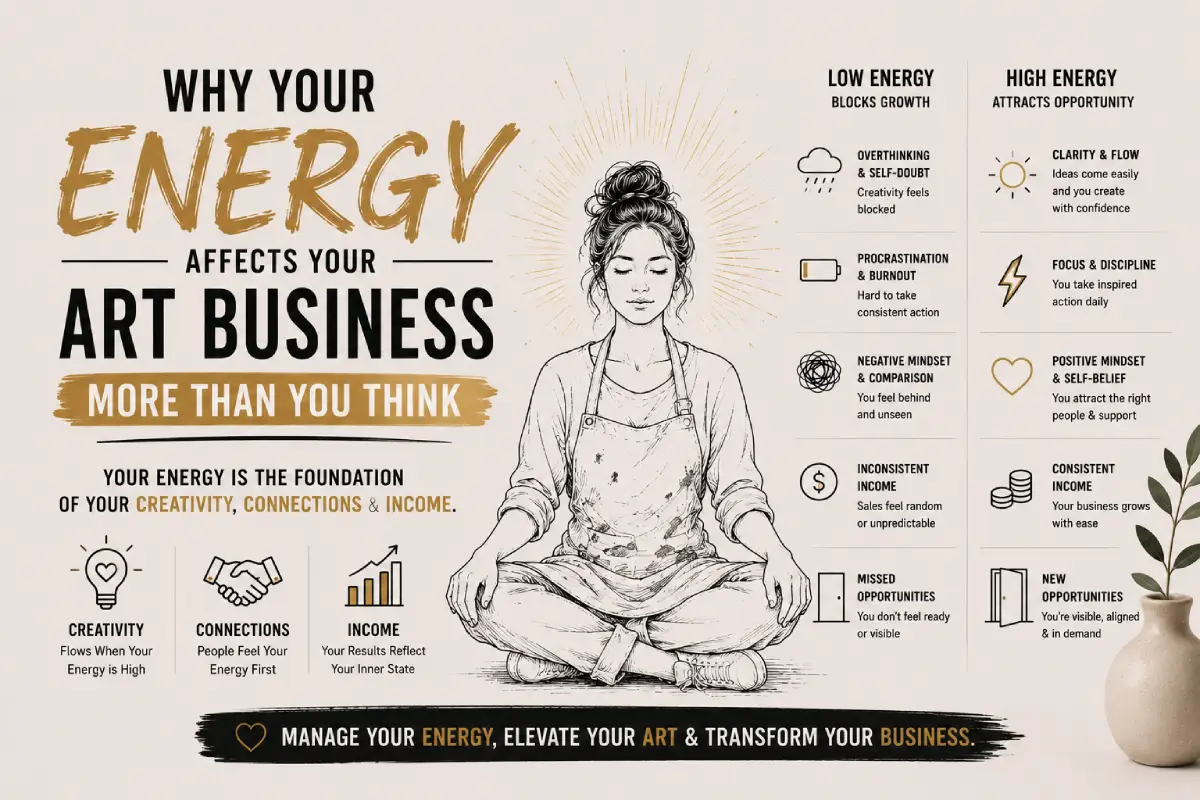
Sometimes, it is emotional energy.
The emotional state artists carry internally affects:
- communication,
- visibility,
- confidence,
- consistency,
- and audience connection more than they realize.
What Does “Energy” Actually Mean?
When people hear the word “energy,” they often imagine something mystical.
But practically, emotional energy simply refers to:
- emotional state,
- mindset,
- confidence,
- emotional stability,
- and internal emotional patterns.
For example:
People can often sense when someone feels:
- desperate,
- anxious,
- confident,
- peaceful,
- or genuine.
Even through content.
Emotional States Affect Communication
An artist who constantly feels:
- insecure,
- fearful,
- or emotionally exhausted
usually communicates differently from someone who feels:
- calm,
- aligned,
- and confident.
This affects:
- captions,
- pricing,
- visibility,
- reels,
- and selling behavior.
For example:
A fearful artist may:
- underprice,
- hesitate,
- over-explain,
- or avoid promoting.
Meanwhile, a grounded artist communicates more clearly and confidently.
A Realistic Example
Ritu from Bangalore creates handmade mandala decor.
Initially, every time she posted products online, her thoughts were:
- “Nobody will buy.”
- “There are too many artists already.”
- “Maybe my work isn’t valuable enough.”
Because of this emotional state:
- she posted inconsistently,
- avoided speaking confidently,
- and hesitated during inquiries.
Eventually she started focusing on:
- emotional healing,
- confidence-building,
- and healthier self-talk.
Slowly her communication changed.
She became:
- calmer,
- clearer,
- and more visible.
Her audience response improved naturally.
The artwork did not change dramatically.
Her emotional state did.
Audiences Emotionally Respond to Authenticity
People are emotionally intelligent.
They can sense:
- sincerity,
- confidence,
- passion,
- and emotional honesty.
This is why creators who communicate authentically often build stronger communities than creators trying to look “perfect.”
Connection matters more than performance.
Fear Creates Emotional Resistance
Many artists unknowingly create emotional resistance around:
- visibility,
- selling,
- success,
- or growth.
For example:
An artist may consciously want:
- more customers,
- more visibility,
- or business growth.
But subconsciously fear:
- judgment,
- criticism,
- failure,
- or responsibility.
This creates internal conflict.
The artist wants growth…
but emotionally fears exposure.
Another Example
An embroidery artist from Chennai constantly compared herself to larger creators online.
This comparison created emotional heaviness.
Whenever she tried creating content, thoughts appeared:
- “I’m behind.”
- “Others are better.”
- “Why would anyone follow me?”
Eventually she realized:
her emotional state was affecting:
- consistency,
- creativity,
- and confidence.
She reduced comparison,
focused on her own audience,
and began creating from a calmer emotional space.
Slowly:
- content improved,
- engagement improved,
- and creativity returned.
Emotional Burnout Affects Business Too
Artists often think burnout only affects creativity.
But burnout also affects:
- communication,
- marketing,
- consistency,
- and audience connection.
An emotionally exhausted artist struggles to:
- show up consistently,
- communicate clearly,
- or create inspiring content.
This is why emotional well-being matters in business too.
Creativity Flows Better in Emotional Safety
The nervous system affects creativity heavily.
When artists constantly feel:
- stressed,
- rushed,
- fearful,
- or emotionally pressured,
creative flow decreases.
But when artists feel:
- calm,
- emotionally safe,
- and internally supported,
ideas flow more naturally.
Why Gratitude and Presence Matter
Many artists constantly focus on:
- what is missing,
- low numbers,
- slow growth,
- or comparison.
This creates emotional scarcity.
Meanwhile, artists who appreciate:
- small growth,
- supportive audiences,
- learning,
- and progress
often feel emotionally lighter and more motivated.
Emotional Alignment Does Not Mean “Positive All the Time”
This is important.
Artists do not need to:
- suppress emotions,
- fake positivity,
- or avoid difficult feelings.
Healthy emotional energy simply means:
- emotional awareness,
- emotional balance,
- and healthier internal patterns.
What Artists Can Start Practicing
1. Reduce Fear-Based Thinking
Constant fear affects communication.
2. Stop Creating Only From Pressure
Creativity needs emotional breathing space.
3. Protect Mental Environment
Comparison affects emotional energy deeply.
4. Build Internal Confidence
Self-worth affects business decisions.
5. Create From Authenticity
Audiences connect with emotional honesty.
The Truth Most Artists Need to Understand
Your art business is not built only through:
- strategy,
- algorithms,
- or marketing.
It is also shaped by:
- emotional state,
- confidence,
- self-worth,
- and inner stability.
Because audiences do not only connect with products.
They connect with people.
And often, the emotional energy behind the art becomes just as powerful as the artwork itself.