Why do some artists confidently:
- teach workshops,
- speak on camera,
- charge premium prices,
- and build strong personal brands…
while other equally talented artists stay:
- invisible,
- hesitant,
- and emotionally stuck?
The answer is not always talent.
Very often, it is internal programming.
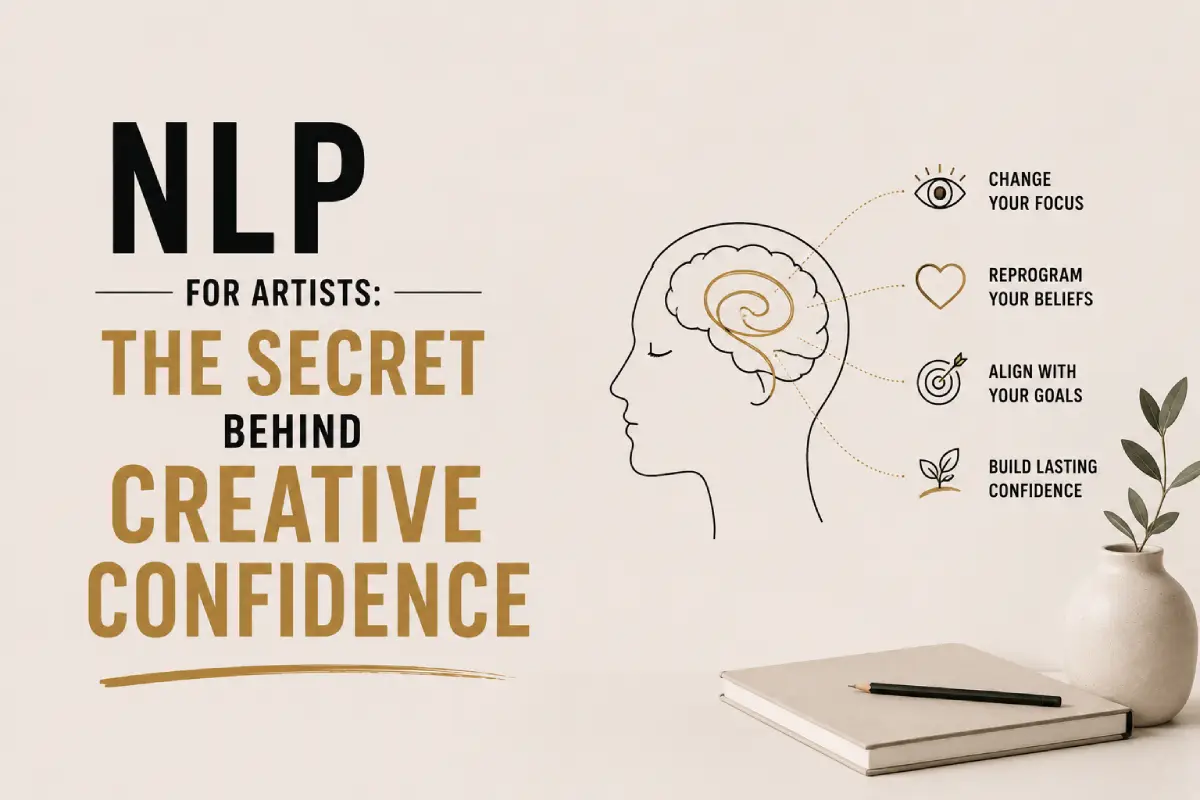
This is where NLP becomes powerful for artists.
What Is NLP?
NLP stands for Neuro Linguistic Programming.
It focuses on understanding how:
- thoughts,
- emotions,
- language,
- and behavior
affect human experience.
In simple terms:
NLP studies how people mentally condition themselves.
Artists unknowingly do this every day.
Through:
- self-talk,
- emotional patterns,
- visualization,
- memories,
- and repeated thoughts.
Confidence Is Not Just Personality
Many artists believe:
“Confident people are naturally born that way.”
Not true.
Confidence is often a trained emotional state.
It develops through:
- repetition,
- emotional experiences,
- self-image,
- and mental conditioning.
This means creative confidence can actually be strengthened intentionally.
A Common Artist Struggle
Many artists feel confident while creating art privately…
…but uncomfortable when it comes to:
- visibility,
- selling,
- teaching,
- or speaking publicly.
Why?
Because artistic skill and self-expression confidence are different things.
An artist may master:
- painting,
- embroidery,
- or mandalas,
while still emotionally struggling with:
- fear of judgment,
- camera anxiety,
- pricing guilt,
- or self-doubt.
A Realistic Example
Swathi from Chennai creates beautiful dot mandala artwork.
Offline, people constantly appreciated her work.
But online, she felt extremely uncomfortable.
Every time she recorded a reel:
- she restarted repeatedly,
- criticized her voice,
- and overthought every sentence.
Internally, her mind kept repeating:
“I’m not confident enough.”
This belief became emotional conditioning.
Eventually she began practicing simple NLP-based shifts:
- changing internal language,
- visualizing successful communication,
- and reducing negative self-talk.
Slowly:
- camera fear reduced,
- consistency improved,
- and she became more visible online.
Not because she became a different person.
Because she changed her internal emotional patterns.
The Subconscious Mind Influences Creativity
Many artists focus only on external strategy.
But subconscious emotional patterns strongly affect:
- confidence,
- visibility,
- creativity,
- consistency,
- and business growth.
For example:
If an artist subconsciously associates visibility with embarrassment…
they may unconsciously avoid:
- posting,
- speaking,
- or showing themselves online.
This appears externally as:
- procrastination,
- perfectionism,
- or inconsistency.
NLP Helps Artists Reframe Fear
One important NLP concept is reframing.
This means changing the emotional meaning attached to situations.
For example:
Instead of viewing:
“Low reel views = failure”
an artist can reframe it as:
“Feedback for improving communication.”
Instead of:
“People may judge me”
reframe as:
“The right audience may deeply connect with me.”
This reduces emotional intensity.
Why Visualization Helps Creative Confidence
Many successful performers, athletes, and speakers use visualization techniques.
Artists can use similar methods.
For example:
Before teaching a workshop, an artist can mentally rehearse:
- calmness,
- confidence,
- audience connection,
- and successful communication.
This conditions the nervous system gradually.
Another Example
A jewelry artist from Pune struggled speaking during live sessions.
She constantly feared:
- forgetting words,
- sounding awkward,
- or making mistakes.
Instead of avoiding lives completely, she practiced:
- short rehearsals,
- positive visualization,
- and calming internal language.
Over time:
- anxiety reduced,
- confidence improved,
- and audience engagement increased.
The skill improved because the emotional fear reduced.
Artists Often Need Emotional Safety First
Creativity flows best when the nervous system feels safe.
Constant:
- self-criticism,
- comparison,
- or fear
creates emotional tension.
This tension affects:
- expression,
- consistency,
- and confidence.
NLP techniques often help artists create healthier emotional patterns internally.
Why Identity Matters
People behave according to how they identify themselves internally.
An artist who subconsciously believes:
“I’m just a hobby artist”
may hesitate to:
- charge properly,
- teach confidently,
- or market seriously.
But when identity shifts toward:
“I am a professional creative entrepreneur,”
behavior gradually changes too.
Practical NLP-Based Shifts for Artists
1. Observe Internal Language
Notice repeated negative self-talk.
2. Replace Extreme Thinking
Avoid words like:
- “always,”
- “never,”
- “everyone,”
- “nobody.”
3. Practice Positive Visualization
Mentally rehearse successful outcomes calmly.
4. Reduce Fear-Based Focus
Stop replaying embarrassment repeatedly.
5. Build Confidence Through Small Repetition
Confidence grows gradually through action.
The Truth Most Artists Need to Hear
Creative confidence is not reserved for extroverts.
It is not something only “naturally confident people” have.
Confidence can be developed.
Artists do not need to eliminate fear completely.
They simply need healthier emotional patterns.
Because often, the difference between:
- an invisible artist,
and
- a thriving creative entrepreneur
is not talent.
It is the way they think, interpret, and emotionally condition themselves every day.